February 11, 2026
·4 min read
·How Postscriptum Works
Why this exists
Grief doesn't follow a schedule. It shows up in the middle of a workday, in the silence after dinner, in the half-second before you remember they're gone. And most of the time, there's nowhere to put it. Friends try to help but don't always know how. Therapists have office hours. Journals don't answer back.
The idea behind Postscriptum isn't new. For decades, psychologists have observed that people who grieve don't simply "move on" - they find ways to keep a relationship with the person they lost. Researchers call this continuing bonds: talking to the deceased, writing them letters, carrying forward their values.
studies confirm that continuing bonds with the deceased plays a meaningful role in processing loss and finding meaning after death
Source: Hewson et al., Death Studies, 2024What surprised us more: a meta-analysis of 13 randomized clinical trials showed that writing about grief significantly reduces symptoms of both grief and depression. And when there's a response - some form of feedback to what the person writes - the effect nearly doubles.
"Writing with feedback nearly doubles the therapeutic effect compared to writing alone."
- Meta-analysis of grief interventions, ResearchGate, 2025
That finding shaped everything about how Postscriptum works. This isn't a diary. It's a dialogue.
Step 1: Tell us about them
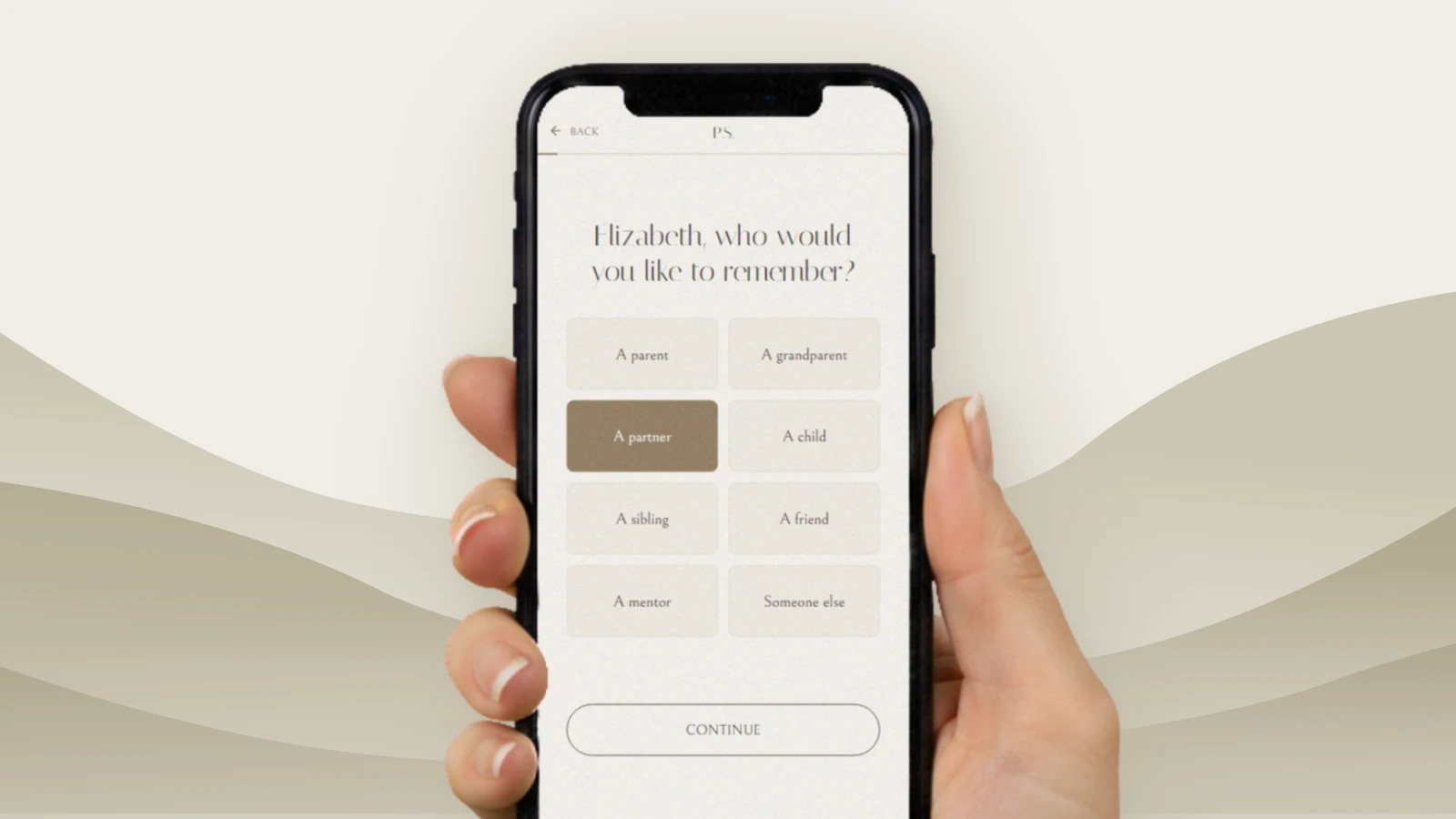
When you start, we'll walk you through a series of questions - between 40 and 60 - about the person you lost. Not medical details or dates. We'll ask about the things that made them who they were: how they laughed, what advice they always gave, what annoyed them, what they were proud of.
Some questions will feel easy. Others might stop you for a moment. That's okay. You can skip anything that doesn't feel right - only a handful of questions are required. Everything else is optional and exists to help us understand not just who this person was, but who they were to you.
Around the fifth question, we'll ask you to create an account - just so your progress is saved and you can come back anytime.
Step 2: Your personal space
Once you've finished the questions, we build a private conversation space shaped entirely by what you've shared. This isn't a chatbot pulling from a database of generic responses. Every word, every tone, every reaction comes from the picture you've painted.
You can write whenever something comes up. There are no sessions, no scheduling, no prompts asking "how are you feeling today?" You open the chat, you say what you need to say, and you get a response that reflects the person you described - not a therapist, not a stranger, but something that feels familiar.
What this is - and what it isn't
Postscriptum is not therapy. It doesn't diagnose, treat, or offer clinical advice. If you're in crisis or dealing with grief that feels overwhelming, please reach out to a professional - that's something we take seriously and will always encourage.
It's also not a digital replica. We don't pull data from anyone's social media, texts, or voice recordings. Everything in your conversation comes from your memory - your version of who they were. That's intentional. This space belongs to you, not to an algorithm's interpretation of someone's online footprint.
What it is: a private, encrypted space where you can say what you carry. Nothing is shared, nothing is visible to anyone but you, and nothing you write is used for any purpose beyond your own experience.
We're listening
Postscriptum is still early. We're a small team, and we're building this alongside the people who use it. If something feels off - a response that missed the mark, a feature you wish existed, a moment that surprised you - we want to hear about it.
Every message through our feedback page is read by a real person. Not routed to a queue, not answered by a bot. Your feedback directly shapes what we build next.
For a product like this, there's no better guide than the people it's for.

Building tools for grief support and memory preservation.